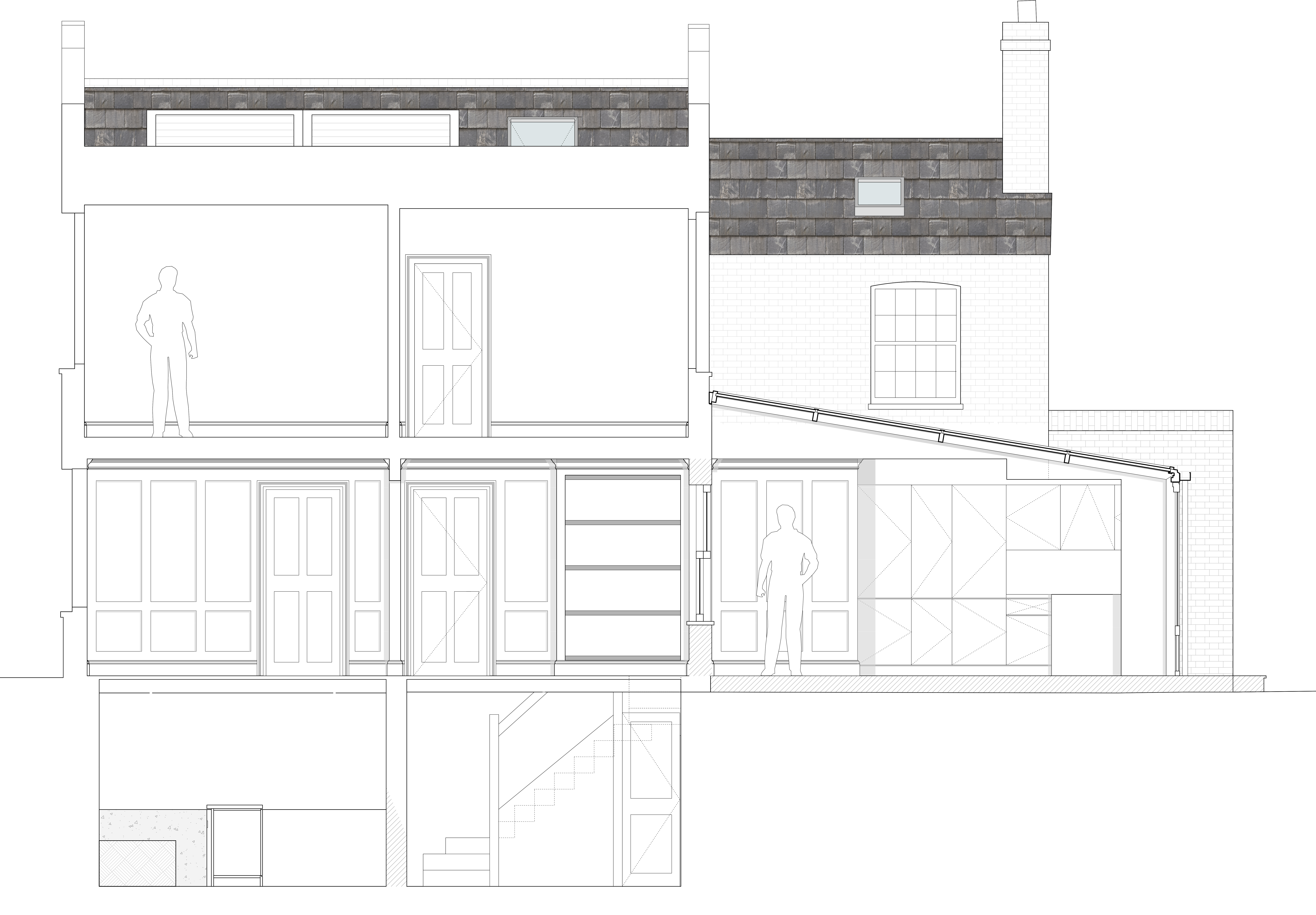
Roupell Street, tucked behind Waterloo, is one of those London streets that feels suspended in time. A terrace of Grade II listed workers’ houses, it has survived the Blitz, appeared in period films and remained largely intact while the city around it has transformed. It is a conservation success story — and, as our recent work shows, a real challenge for anyone trying to adapt a historic home to modern life.
Our clients own one of these cottages. Like many others along the terrace, the house still bore the marks of its Victorian origins: a very low, awkward basement and a lightweight rear lean-to with a makeshift roof. Over the years, neighbouring homes had been extended, basements lowered and layouts reworked, all attempts to make these compact houses function better for contemporary family life.
The brief was easy to describe but difficult to deliver. The clients wanted to lower the basement so it could be used comfortably, replace the tired rear lean-to with a more refined infill extension, and improve the ground floor layout so the house worked properly as a family home. Architecturally, it is a modest project. Strategically, it raises a much bigger question: how do listed homes evolve without losing the character that makes them special in the first place?
From the outset, the planning journey was never going to be straightforward. The terrace is listed as a group, meaning every change is judged not just on its own merits but in relation to the entire street. While many neighbouring properties had already been adapted — some extensively, particularly following wartime damage — precedent alone carried limited weight.
Our first submission progressed with very little engagement until just days before determination, at which point it became clear that the proposals had not been fully understood in the context of the building. We were advised to withdraw or face refusal. We withdrew, revisited the scheme and strengthened the heritage case with additional specialist input before resubmitting. Even then, the process remained slow and demanding.
In total, securing permission took over two years.
What made the process particularly challenging was not the principle of heritage protection, which we fully support, but the lack of clarity and consistency along the way. Advice shifted, expectations changed and relatively small details became significant hurdles. Robust negotiation is part of our everyday work, but this was a rare example where meaningful dialogue was difficult to establish.
The final approved scheme is more restrained than the clients originally hoped for, but it still delivers real, tangible improvements. The basement is now lowered and genuinely usable, the rear lean-to is replaced with a considered infill extension, and targeted internal changes improve light, flow and functionality while respecting the listed fabric of the house. It is not a radical transformation, but it is a meaningful one — and one that allows the house to be lived in properly again.
Roupell Street reinforced several things we already believed. Heritage and habitability must be held in balance; preserving character should not mean compromising basic functionality. The best conservation outcomes come from open, early dialogue between architects, planners, conservation officers and residents. On sensitive listed projects, expectation-setting is essential, and we now front-load conversations with clients around timeframes, risk, the need for early specialist input and the emotional reality of long planning journeys. Above all, persistence matters. The outcome here required steady advocacy, careful rethinking and commitment from everyone involved.
Roupell Street is small in physical scale, but larger in what it represents. As architects, we are not only designing buildings. We are negotiating between past and present, helping historic homes remain lived-in, loved and part of a living city — rather than becoming relics frozen in time.